 The British Geophysical Association
Postgrad/PhD opportunity – Peat Bog Geophysicist @ UoSwansea
Dear all,
under the umbrella of a project called ‘An interdisciplinary assessment of human and climatic impacts on Holocene peat bogs in SW Wales’.
The website has a lot of details on the projects and the application process. Please contact Dr. Bernd Kulessa (b.kulessa@swansea.ac.uk) and/or Prof. Siwan Davies (siwan.davies@swansea.ac.uk) for any further information.
If possible, please forward this message to any suitable candidates you may be aware of.
Best wishes,
Bernd
JOB – Earthquake Seismologist @BGS
The British Geological Survey (BGS) is one of the world’s leading and forward thinking geological science institutes with a focus on both public good science for government and geoscientific research to understand earth and environmental processes. BGS has a long track record of studies of seismic hazard around the world and is recognised internationally as an authority on seismic hazard methodology and associated software development, and has pioneered developments in stochastic modelling (Monte Carlo simulation) for probabilistic seismic hazard, and the use of source model validation techniques.
We are seeking an innovative and dynamic scientist with good mathematical skills to join our Earthquake Seismology Team and pursue a programme of research in seismic hazard. Areas of interest include the development of methods for probabilistic seismic hazard, modelling strong ground motions, statistical seismology, modelling stress transfer between faults and induced seismicity. You will also play a key role in commercial seismic hazard work for engineering projects, the insurance sector and government, and support the Team’s wider research interests in earthquake seismology. The varied nature of the work will include opportunities to present that work at international conferences and exhibitions and deal with the media.
You should have a PhD in physical/mathematical sciences or engineering with a record of research in seismic hazard or a related area. You should also have good general understanding of earthquake seismology. You should possess good programming skills, with competence in at least one programming language. In addition, you must possess excellent communication skills, both oral and written, ideally with a proven record of publishing your research and the ability to present it to an expert audience. The post involves team working, therefore you should be able to work effectively with others and have good time management skills.
Depending on qualifications and experience, starting salary for the role will be £26,715 per annum to £37,875 per annum (pay award pending). For a salary above £31,330 per annum you would need to have research experience in seismic hazard/ground motion modelling, practical experience of seismic hazard assessment and able to develop and lead new work in your particular field of expertise.
Working hours will be 37 per week excluding lunch breaks. A generous benefits package is also offered, including a company pension scheme, childcare voucher scheme, 30 days annual leave plus 10.5 days public and privilege holidays.
This is advertised as a full time post but we will consider applications from those who require more flexible arrangements.
If you are interested in this role and want to be responsible for solving complex scientific and business problems under own initiative, being exposed to wide range of technologies and have the opportunity to contribute to scientific output of organisation together with the possibility of representing the organisation at international scientific conferences then please visit RCUK Shared Services Centre job board at http://www.topcareer.jobs/ and submit your up-to-date C.V. and covering letter, which clearly outlines why you are applying for this post and how you meet the criteria described in this advertisement. Applicants who would like to receive this advert in an alternative format (e.g. large print, Braille, audio or hard copy), or who are unable to apply online should contact us by telephone on 01793 867003, Please quote reference number IRC175033.
Closing date for receipt of application forms is 25 January 2015.
The Natural Environment Research Council is an equal opportunities employer and welcomes applications from all sections of the community. People with disabilities and those from ethnic minorities are currently under-represented and their applications are particularly welcome. The British Geological Survey is an Investors in People organization and has achieved Bronze status for Athena Swan – a scheme that recognizes excellence in women’s employment in science, technology, engineering, maths and medicine (STEMM) in UK higher education. There is a guaranteed Interview Scheme for suitable candidates with disabilities.
This message (and any attachments) is for the recipient only. NERC is subject to the Freedom of Information Act 2000 and the contents of this email and any reply you make may be disclosed by NERC unless it is exempt from release under the Act. Any material supplied to NERC may be stored in an electronic records management system.
Upcoming meeting!
BGA NAG2015:
The Lithosphere-Asthenosphere Boundary
***************************************
Register here.
***************************************
Rosetta… Countdown to landing
Rosetta is a robotic space probe built and launched by the European Space Agency to perform a detailed study of comet 67P/Churyumov–Gerasimenko. It was launched on 2 March 2004 on an Ariane 5 rocket and reached the comet on 6 August 2014. The spacecraft consists of two main elements: the Rosetta space probe orbiter, which features 12 instruments, and the Philae robotic lander, with an additional nine instruments.
As the comet 67P approaches the sun, it will start to heat up – the ice will turn to gas and escape from the comet, a process we currently know little about. The Rosetta orbiter and the Philae lander will observe the behaviour of the comet on its solar approach.

Visualisation of Philae on comet 67P
For the past few weeks, scientists have been studying 67P for viable landing sites for Philae. The final site selection has now taken place and landing is scheduled for the 12th of November. The location, dubbed Site J, on Comet 67P/Churyumov-Gerasimenko, offers the greatest scientific promise and the least risk compared to other places under consideration.
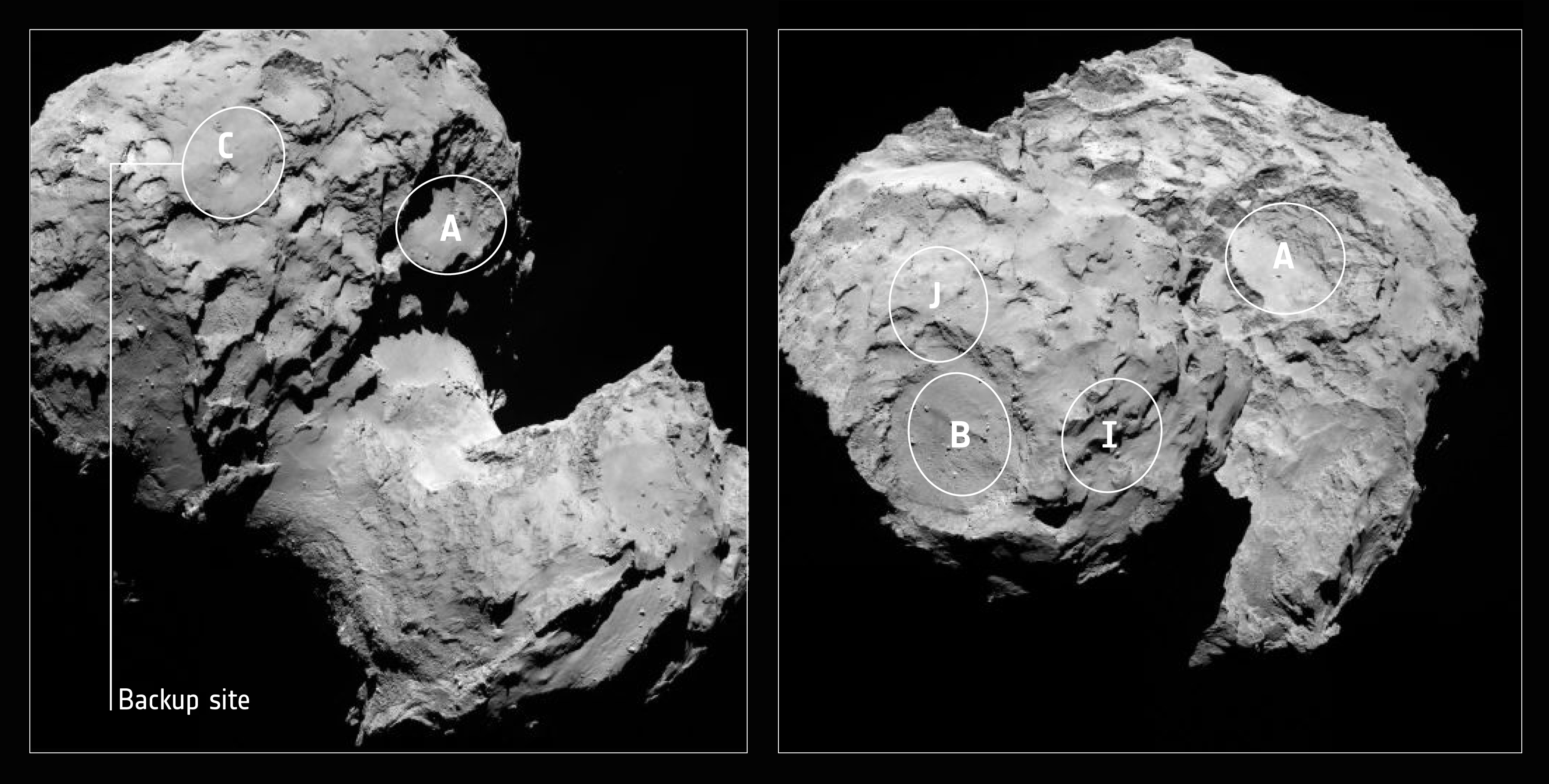
Proposed landing sites
To watch a video about the landing, see below:
New satellite maps out Napa Valley earthquake
Scientists have used a new Earth-observation satellite called Sentinel-1A to map the ground movements caused by the earthquake that shook up California’s wine-producing Napa Valley on 24 August 2014.
“This satellite represents a sea change in the way we will be able to monitor catastrophic events, such as earthquakes and volcanic eruptions, due to its systematic observation strategy.” – Professor Andy Hooper, COMET
This is the first earthquake to be mapped by the European Space Agency’s (ESA) new satellite and demonstrates the capabilities of the Centre for the Observation and Modelling of Earthquakes, Volcanoes and Tectonics (COMET) in analysing its observations quickly.
For more information, see the full blog post here.
Iain Stewart – Anatomy of an Earthquake
NERC has teamed up with BBC presenter Professor Iain Stewart and Shadow Industries, a Bristol-based production company, to create a new short film called ‘Anatomy of an Earthquake’.
The film uses graphics to provide an introduction to the physical causes of earthquakes, and what happens when a seismic hazard deep beneath the Earth’s surface meets a vulnerable city above. It also asks how we can prepare our mega-cities for a direct seismic strike, as people around the world flock to urban centres.
“Earthquakes are one of the planet’s most lethal natural forces”
The film was created with the GCSE and A’ Level curricula in mind, and is intended as a new resource to introduce students to the topic.
It was created in partnership with NERC’s British Geological Survey and Earthquakes without Frontiers, a programme jointly funded by NERC and the Economic & Social Research Council (ESRC) to improve understanding of the physical and social factors that cause vulnerability to earthquakes on continental interiors.
 The British Geophysical Association